| |
| Why are battery power-supply, fiber data transfer and small front-end
size so important ? |
| |
| The
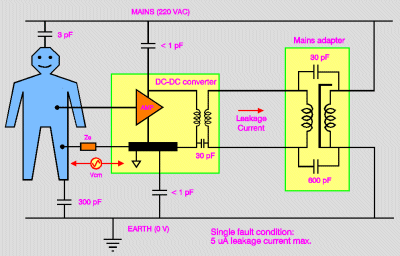
combination of a battery-powered front-end and optical fiber offers
minimal leakage currents in both normal operation an under fault
conditions. During normal operation this assures the best possible
rejection of all kinds of interference. Common mode as well as differential
mode interference voltages are therefore reduced far below the amplifier
noise level. Although high CMRR may solve the common mode problem
in mains powered systems, the differential mode interference remains
at least a factor of 10 worse than with our battery powered setup.
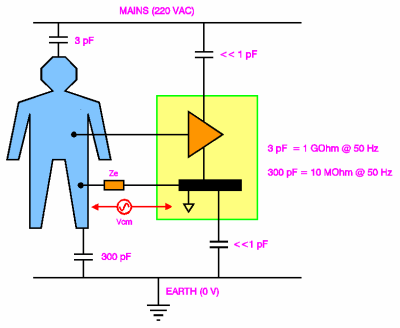
An additional advantage of the battery powered setup is the very
high protection for shock-hazard caused by the mains-supply. Because
of the fiber optic data transfer, the safety situation is completely
determined by the capacitance between the subject and the environment.
Because the dimensions of the front-end are very small compared
to the dimensions of the subject and because the front-end is located
very close to the subject, the capacitance between the subject and
the environment is not significantly increased by connecting the
front-end to the subject. Therefore the biopotential measurement
does not alter the situation in terms of protection against shock
hazards and leakage currents are well below the IEC 601-1 CF specifications. |
|
|
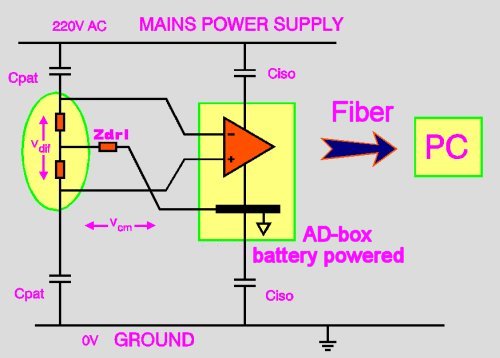
| Leakage
currents through Zdrl cause Common mode interference (Vcm) AND Differential
mode interference. The first one can be eliminated with a high
CMRR, but the last one can not be decreased by the instrumentation.
The amount of leakage current is directly dependent on the value of
the isolation capacitance. The best way to keep this capacitance as
small as possible is the use of a compact battery powered front-end
close to the subject, in combination with fiber-optic data transfer
to the data processing hardware. |
| |
| |
| |
|
Battery
powered |
|
Mains
powered |
|
|
|
| What happens when multiple AD-boxes are connected to 1 subject? |
| |
Connecting two Active3 systems to the same subject is not a good measurement setup. There will be errors when channels of one system are referenced to channels of the other system. There are two reasons for these errors. Firstly, the channels are measured with respect to different references (each system has its own CMS and DRL). Secondly, the internal clocks of the systems are not synchronized, so there will be slight timing differences between the sample moments of the two systems, which leads to "sampling skew" distortion.
The above errors do not play a role during BioSemi Triggered Hyperscanning with multiple subjects, because in that case channels of one subject are not referenced to channels of another subject. |
|
|